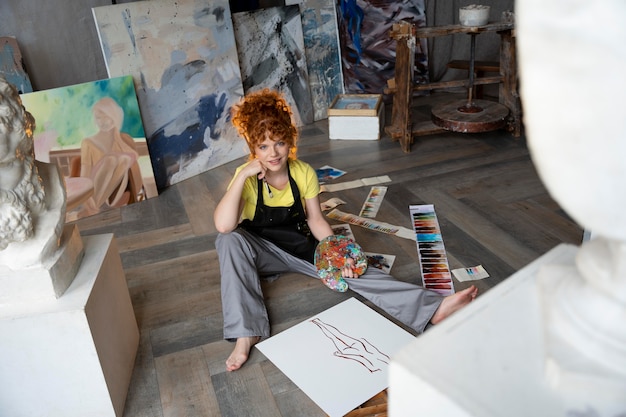
Humanity has always sought ways to communicate its deepest truths. Among the many languages available to us, the visual arts hold a unique position. They bypass words and speak directly through images, colors, and forms. The result is a universal dialogue where memory, imagination, and identity converge. This enduring tradition of storytelling through art allows cultures to preserve histories, transmit values, and ignite new perspectives.
The Ancient Origins of Visual Narratives
From the earliest cave paintings, humans used imagery as a means of narration. Hunters painted animals to describe their encounters, rituals, or aspirations. Symbols carved into stone carried meaning that echoed across generations. These primal marks were not only decorative but vital acts of visual cultural expression, giving voice to communities long before written language emerged.
Ancient Egypt offers a particularly vivid example. Tomb paintings and hieroglyphs detailed journeys into the afterlife, blending myth with biography. Similarly, Greek pottery depicted epic tales, from heroic battles to divine encounters. These artifacts are not relics of mere aesthetics. They are creative narrative works, carefully designed to ensure stories endure across centuries.
Medieval and Renaissance Storytelling
As civilizations evolved, so too did the sophistication of artistic storytelling. In medieval Europe, stained glass windows illuminated biblical tales for congregations who could not read. Every panel was a chapter, combining symbolism and color to narrate salvation history. During the Renaissance, artists such as Giotto and Michelangelo expanded these traditions, turning walls and ceilings into sprawling theaters of narrative imagination.
These masterpieces illustrate how artistic story ideas extend beyond single images. Instead, they weave together complex sequences, inviting viewers to contemplate layers of meaning. Whether through allegory, portraiture, or epic tableau, artists became authors whose medium was pigment and perspective.
Cultural Narratives Across the World
Outside Europe, rich traditions flourished in equal measure. Indigenous cultures across the Americas expressed origin myths through carvings, textiles, and murals. In Asia, scroll paintings and temple murals captured entire cosmologies within their intricate compositions. Aboriginal Australians painted Dreamtime stories on rock surfaces, linking the spiritual and the earthly in vivid patterns.
Each of these works is a form of visual cultural expression that anchors identity within community. They serve as cultural archives, holding not just legends but also ethical teachings, social structures, and ecological knowledge. The universality of storytelling through art becomes evident when one sees how distant cultures used it to answer the same questions: Who are we? Where do we come from? What sustains us?
Modern and Contemporary Storytelling
In the modern era, artists began to experiment with new ways of narration. Movements such as Surrealism and Cubism fractured conventional perspectives, suggesting that stories could be told through abstraction, dreamlike imagery, and fragmented forms. Murals in 20th-century Mexico, pioneered by figures like Diego Rivera, brought historical and political narratives into the public sphere, turning entire city walls into creative narrative works accessible to all.
Today, contemporary artists use photography, film, installations, and digital media to explore new frontiers of narrative. Technology expands possibilities, allowing interactive and immersive experiences. Virtual reality, for instance, places viewers inside the story itself. These innovations continue to generate fresh artistic story ideas, blending tradition with experimentation.
Emotional and Psychological Power
The strength of visual storytelling lies in its ability to touch the human psyche. A single image can evoke joy, grief, or wonder in ways words cannot. Symbolism enriches this effect, embedding deeper meanings within seemingly simple forms. A color palette can suggest mood, while composition can dictate how a story unfolds.
Through these tools, storytelling through art becomes a dialogue between artist and viewer. Each person interprets the narrative differently, shaped by their own experiences and emotions. This openness creates a living relationship with the artwork, where meaning evolves across time.
Art as Collective Memory
Beyond individual engagement, art also functions as a collective memory. Monuments, murals, and public artworks capture defining moments of history, ensuring that they remain part of communal consciousness. They remind societies of victories, struggles, and aspirations. Such works become visual cultural expression at its most profound, embedding shared identity into physical space.
Examples abound, from memorials commemorating tragedies to street art championing social justice. These pieces illustrate how creative narrative works remain vital tools for dialogue and activism, shaping the cultural fabric of modern life.
The visual arts stand as one of humanity’s oldest and most enduring storytellers. From cave walls to digital installations, they reveal how artistic story ideas evolve yet remain rooted in a universal desire to communicate meaning. Through storytelling through art, societies preserve memory, provoke thought, and spark imagination. Through visual cultural expression, individuals and communities alike find their voices, their values, and their visions for the future.
In every age and every place, art continues to remind us that stories are not only told in words. They live in colors, shapes, and forms, carrying human truth across time and space.